
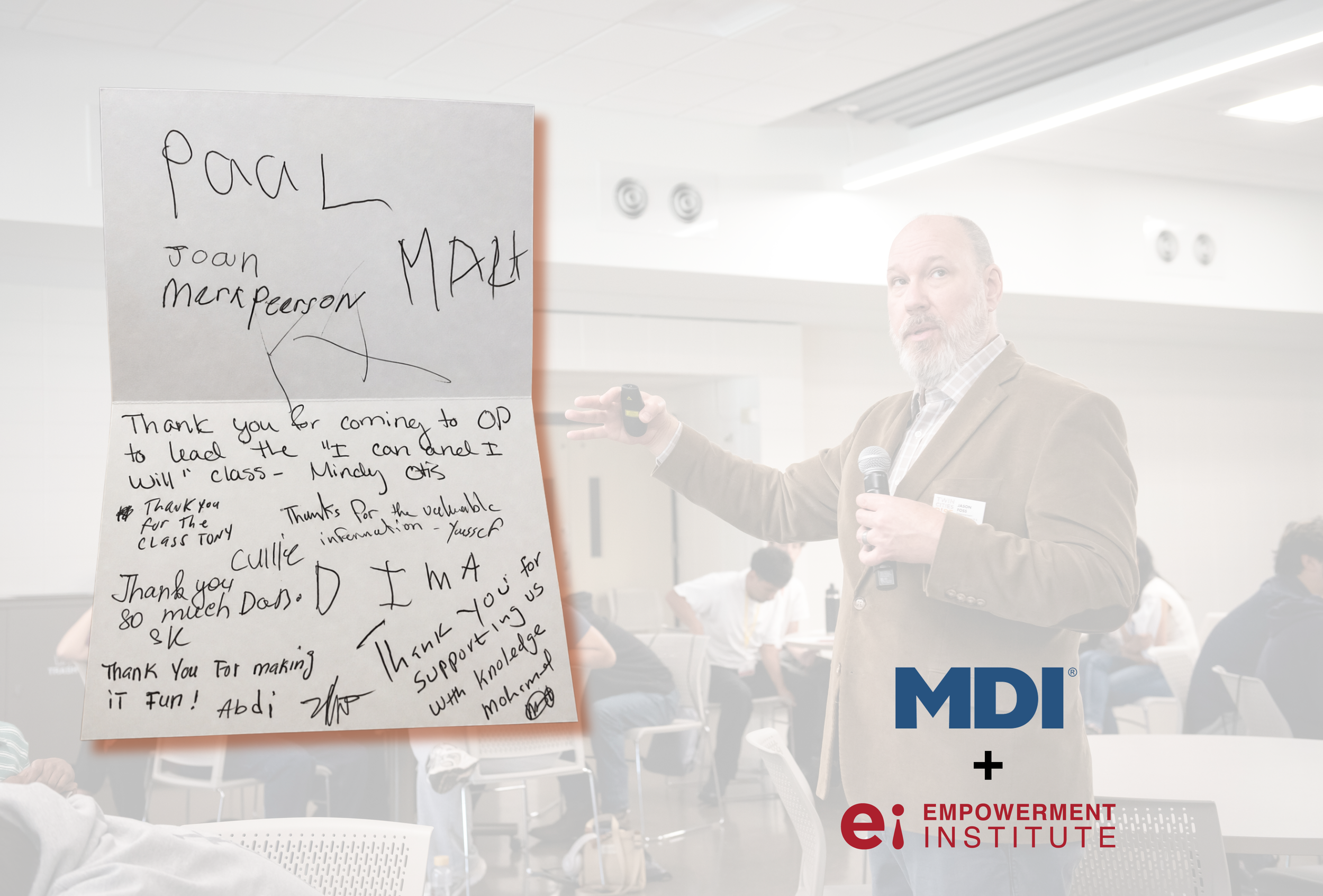
Thank you card from MDI to Empowerment Institute Facilitator, Jason Foss.
“I think a lot of our participants feel a lot of different emotions throughout the day working in a fast-paced warehouse environment. This training taught them how to slow down and recognize those emotions so they can react appropriately.”
— Kris Bensen
Employment Support Specialist, MDI
When a machine breaks down on a production floor, frustration is understandable. What happens next can affect far more than one employee.
At MDI, the Empowerment Institute is helping learners and employees recognize what they are feeling, manage their reactions, and communicate more effectively during real workplace challenges.
The Emotional Intelligence training is offered several times throughout the year and has been adapted to meet the needs of MDI’s learners. Sessions combine group learning, discussion, questions, and reflection so participants can connect what they are learning to situations they experience at work.
Ryan Anderson of MDI sees the training as another part of preparing people to succeed in employment.
“It adds a really nice piece to the puzzle of skills that people need to be successful in the workplace.”
When Frustration Shows Up at Work
For MDI, the impact of the training is visible in everyday moments.
Kris Bensen, Employment Support Specialist at MDI, has seen participants use what they learned when equipment problems interrupt the workday.
“Often times our machines break down, which can cause frustration. Those individuals have been able to be an example on how to react professionally to those setbacks, which others have observed as well.”
Kris has also noticed participants becoming more aware of their feelings and more willing to talk with supervisors about their thoughts and frustrations.
Those changes matter in a fast-paced workplace. Employees experience stress, setbacks, disagreement, and frustration. Emotional Intelligence gives them tools to recognize what they are feeling before deciding how to respond.
Creating Space to Slow Down
Reflection is an important part of the training.
Kris remembers one activity where participants were asked to think about a time when their reaction to an emotion affected another person.
One participant shared that he had become intentional about coming to work with a positive attitude, even when something difficult was happening outside of work.
“Whatever negative is happening in his life, he is focused to make sure he leaves it at the door and goes to work with a professional and positive attitude.”
For Kris, one of the biggest benefits is helping participants slow down enough to recognize their emotions before reacting.
“This training taught them how to slow down and recognize those emotions so they can react appropriately.”
Ryan has seen another benefit in the conversations that happen during training. Participants have opportunities to answer questions, hear from each other, and recognize that they may not be the only person experiencing a difficult emotion.
“There’s power in realizing you’re not maybe the only person in the room that feels sad or overwhelmed or stressed out about something.”
Training Built for MDI
The Empowerment Institute has worked with MDI to adapt the training to fit its learners and learning environment.
“They’ve done a good job of adapting their training to meet our needs,” Ryan said.
Jason Foss, Empowerment Institute facilitator, has played an important role in creating that experience at MDI. Ryan described Jason’s training approach as patient, empathetic, and welcoming, helping participants feel comfortable engaging with the training.
Kris also pointed to the interactive format as one of the things that stood out about the training. Participants are not simply listening to a presentation. They are being asked questions, reflecting on their own experiences, and thinking about how they can apply what they are learning.
At MDI, those lessons are carrying over into the workplace. Participants are becoming more aware of their emotions, communicating more openly with supervisors, and showing others how to respond professionally when challenges come up.
The result is practical Emotional Intelligence that employees can use when it matters most: during the real moments they face at work.